4-base capture the flag is how you run the game when the crowd is too big for two teams. Four teams, four flags, four corners of one field. Players raid, defend, and dodge across an outdoor space with action everywhere at once. It fixes the pile-up that wrecks a huge two-team game.
4-base capture the flag splits a large group into four teams, each holding a flag in its own corner. Every team attacks and defends at the same time, so there’s no idle center-line standoff. You win by capturing enemy flags while guarding your own, and the extra teams spread the crowd out.
| Players | 40-100+, split into four even teams |
| Time | 30-50 minutes, or shorter rounds |
| Ages | 8 and up |
| Space | Large field, at least 40 x 40 meters |
| Gear | 4 colored flags, 4 team colors, cones or rope, jails |
| Best for | Big crowds that overwhelm a two-team game |

Table of Contents
What Changes With Four Teams
4-base capture the flag keeps the core of the classic game. Tagging, jail, freeing, the safety radius, all of it holds. For those, read the full capture the flag rules on our main guide. This post covers only what the extra teams change.
Four things shift once you go from two teams to four. The field splits into four zones, not two halves. Every team attacks three rivals at once. Alliances form and break on the fly. And scoring changes, since more than one flag is in play.
What You Need
In 4-base capture the flag, the gear list barely grows. It’s mostly about telling four teams apart on a busy field.
- Four flags in four clearly different colors, one per team. Bandanas or pinnies work.
- Four team colors for players, so nobody loses track of friend and rival.
- Cones or rope to mark four zones and four jails.
- A big field, since four teams need room. Plan for at least 40 by 40 meters.
- One referee per zone if you can, because a busy field needs eyes everywhere.
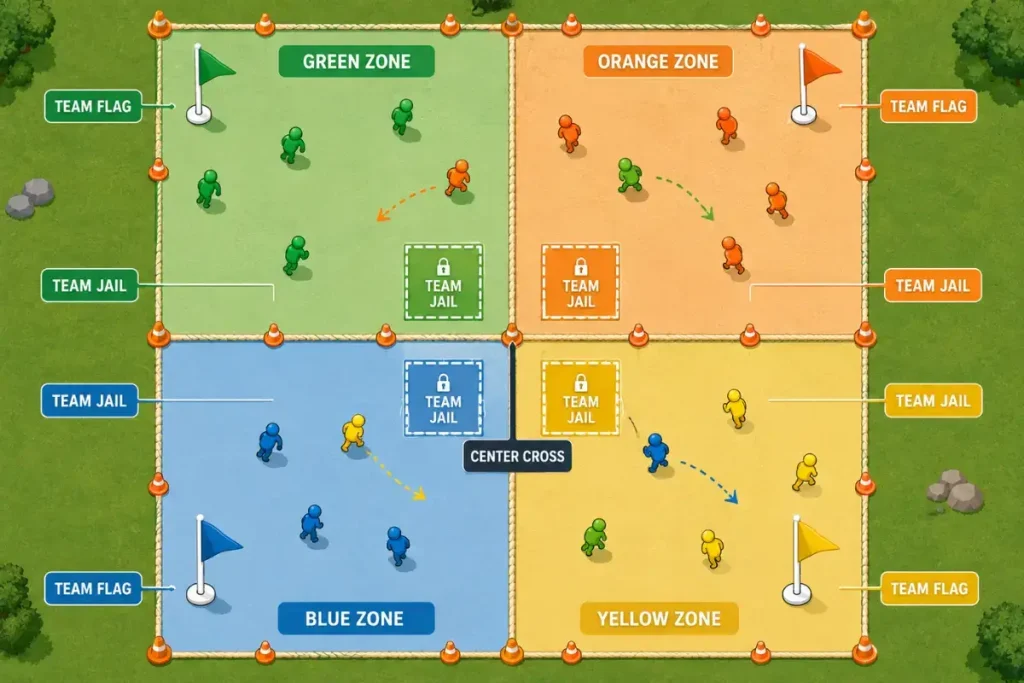
One detail most guides skip: give each team a jail in its own corner, not one shared jail. Four teams need four holding spots, or captured players clog one zone and the rescues turn into chaos.

How To Set Up A Four-Team Game
4-base capture the flag differs from the classic game only in how you divide the field and score, so only those steps are here. For base tagging and jail rules, use the full capture the flag rules.
- Divide the field into four equal zones. Lay rope or cones in a cross, so each team gets one quadrant of the space.
- Give each team a corner and a flag. Set the flag visible and reachable inside each team’s zone, no hiding it high.
- Mark a jail in every zone. Each team holds captured rivals in its own corner, so rescues stay local.
- Assign team colors out loud. Every player wears one color, and you say which color sits where before the whistle.
- Set the win condition first. Decide the win rule now: grab any one rival flag, or collect all three. Say it before play.
How Four Teams Change The Game
Everyone attacks and defends at once
In 4-base capture the flag, no team sits idle. Each one guards its own flag while raiding three rivals, so the whole field stays busy. This kills the standoff that stalls a big two-team game.
Alliances form and break
Two weak teams often gang up on the leader, then turn on each other. It’s part of the fun, and you let it happen. Just remind players that no alliance is official, and a flag grab ends any friendship fast.
Scoring gets bigger
With four flags in play, you need a clear win rule. Two common rules work. First to capture any single rival flag wins, or first to collect all three. Pick one before kickoff so nobody argues the finish.
Flagless teams keep playing
A team that loses its flag isn’t out. They shift fully to offense and raid for others. This keeps everyone moving instead of sending a whole team to the sideline.
Common Four-Team Disputes And How To Settle Them
A four-team field breeds arguments a two-team game never sees. 4-base capture the flag has its own set. Here are the four that come up most, and how to settle each fast.
“Two teams ganged up on us.” That’s allowed, and it’s part of the game. Alliances are never official, so the only fix is to raid back or outlast them. A referee doesn’t break up a gang-up.
“Whose jail does a tagged player go to?” The team that made the tag holds the player in its own jail. Say this at setup, so nobody drags a captive across three zones.
“We lost our flag, are we out?” No. A flagless team plays on as pure offense. State this before kickoff, since players assume losing the flag ends their game.
“Who actually won?” This comes from a fuzzy win rule. Settle it at setup, one flag or all three, and a referee’s call is final on a close finish.
Playing It Safe With A Big Crowd
4-base capture the flag packs a field with four teams, which raises the collision risk, so a few rules matter more here.
- Give a chased player the right of way to stop or turn. No shoulder-checks.
- Keep tags to a light two-hand touch, never a grab or a shove.
- Space the four flags well apart so raids don’t all collide in the center.
- Schedule a water break every 20 minutes in warm weather.
- Call a jail release if one jail holds five or more players too long.
- Use one whistle to pause and two to end, so a big group hears the stop.
Related Big-Group And Multi-Team Twists
| Four Corners | Each team guards its own corner and raids the other three. The standard 4-base setup. |
| Steal-your-colors | Each team’s flags start scattered in rival zones, and you race to bring yours home. |
| Bean-bag scoring | Swap flags for bean bags and count who banks the most. Great for PE class. |
| One-Flag | One neutral flag at center court. Simpler than four teams, good for uneven skill. |
| Nighttime capture the flag | Run the four-team game after dark with glow gear. |
Strategy Tips For Four-Team Play
These win 4-base capture the flag specifically. Reading the other three teams matters more than raw speed.
- Guard light, attack heavy. A team that only defends never scores.
- Watch the leader, since the other teams will swarm whoever’s ahead.
- Send raiders to the weakest zone, not the nearest one.
- Keep one fast defender home, so a lightning raid doesn’t empty your corner.
- Time a raid when two rivals are busy fighting each other.
- Free your jailed players fast, since numbers win a four-way scramble.
4-Base Capture The Flag FAQ
How do you play capture the flag with four teams?
Split a large group into four teams, each with a flag in its own corner of the field. Every team attacks the other three while defending its own flag. A team wins by capturing rival flags under the win rule you set, either any one flag or all three.
How many players do you need for 4-base capture the flag?
It works best with 40 or more, split into four teams of 10 to 20. Fewer than 32 players leaves the field too sparse, so a big two-team game may suit smaller crowds better.
Do you need four jails or one?
Four, one in each team’s zone. The team that tags a rival holds them in its own jail, which keeps rescues local and stops captured players clogging a single spot.
How do you win 4-base capture the flag?
Set the rule before you start. The two common versions are first team to grab any single rival flag, or first team to collect all three rival flags. Pick one so the finish is clear.
Is 4-base capture the flag good for large groups?
Yes, it’s the best format for big crowds. Four teams spread the action across the field and kill the center bottleneck that stalls a huge two-team game.
Round Up A Crowd And Pick Four Corners
Split into four teams, mark the corners, and run a round with your whole group. New to the game? Start with our beginner capture the flag rules first. Want more ways to play? Browse our capture the flag guides and pick your next format.
