Nighttime capture the flag starts the second the field goes dark and someone snaps the first glow stick. Two teams, one glowing marker each, tagging and dodging across an outdoor field you can barely see. The fast player stops winning. The quiet one starts.
Nighttime capture the flag is the classic outdoor game played after dark, with two glowing objects replacing fabric flags and each player wearing team-colored glow bands. Darkness rewards stealth over speed. You light the flags, boundaries, and jails so both teams can find them, then play the same core rules.
| Players | 6-20, split into two even teams |
| Time | 20-45 minutes per round |
| Ages | 8 and up, older skews better after dark |
| Space | Large yard, park, or field with soft edges |
| Gear | 2 glow-stick flags, glow bands per player, LED markers for lines and jails |
| Best light | Low light or dusk, never pitch black |
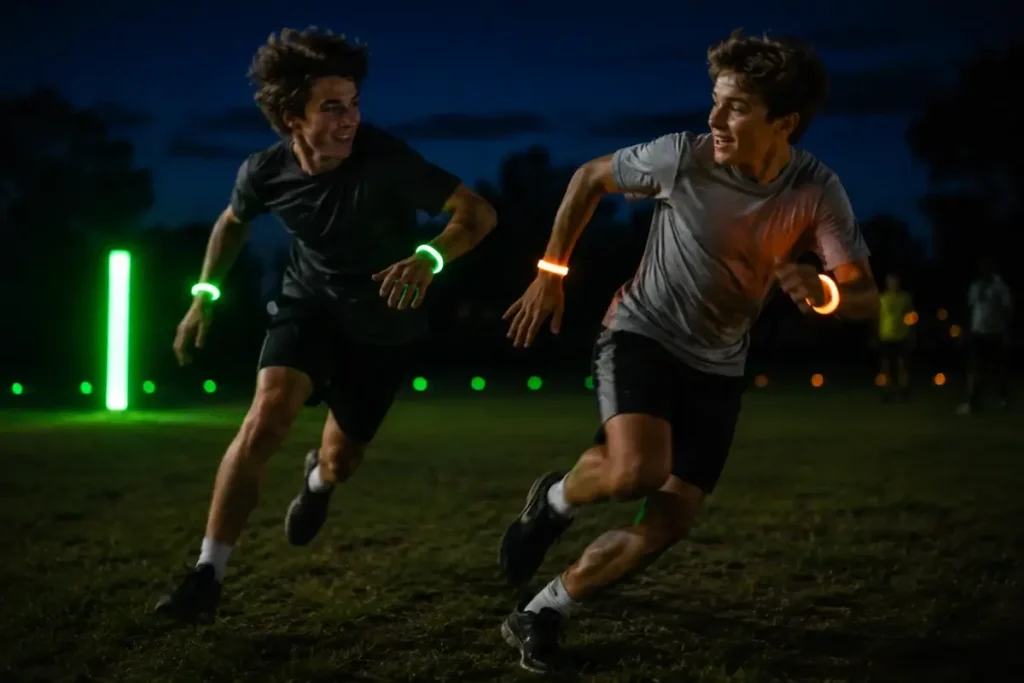
Table of Contents
What Changes When You Play In The Dark
Nighttime capture the flag is the same game you already know, with darkness stacked on top. The jail, the freeing, the safety radius, the way you win, all of it holds. For those, read the full capture the flag rules on our main guide. This post covers only the parts that change.
Three things flip after sunset. Flags become lights. Players wear their team color as glow. And every marker on the field, center line, boundaries, and both jails, has to glow too. That tree over there, the brown one, is a useless boundary at 9pm. If it doesn’t glow, it doesn’t exist.
What You Need
Cheap gear beats a pricey kit for nighttime capture the flag. Skip the branded glow bundles. A pack of large glow sticks and a bag of bracelets covers most of it.
- Two large glow sticks or light-up orbs in clearly different colors, one per flag
- Glow bracelets or LED bands, two per player, matching their team’s flag color
- LED marker lights or spare glow sticks for the center line, boundaries, and each jail
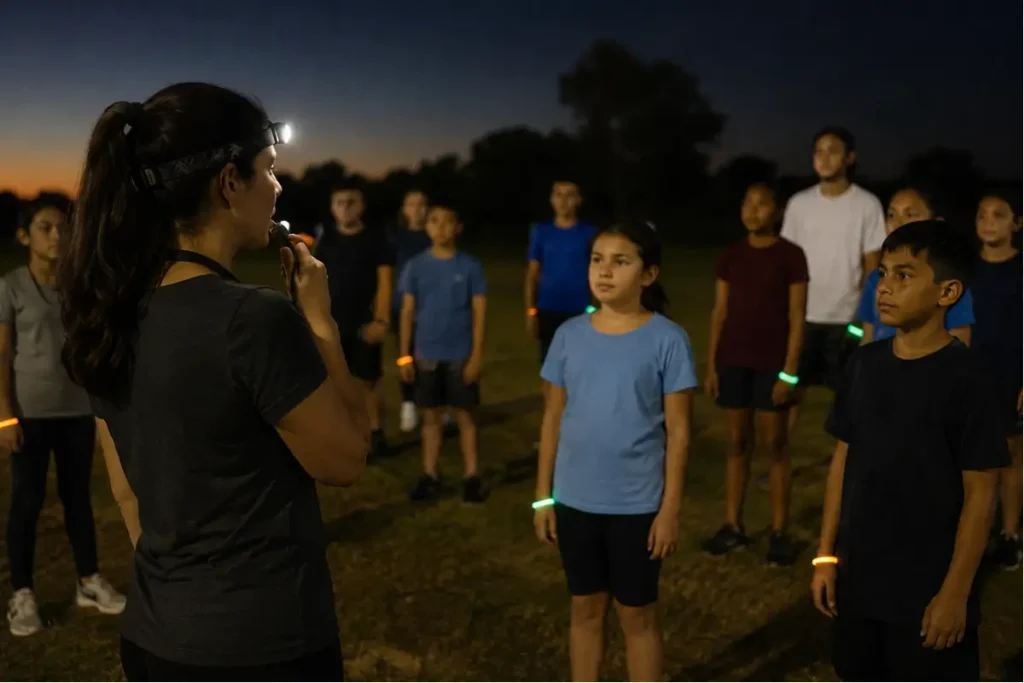
- Flashlights or headlamps for leaders, plus one spare set of batteries
One detail people always miss. Don’t crack the glow sticks until just before start. They burn 6-12 hours, but you want that glow at peak, not half-spent while everyone’s still picking teams.
How To Set Up Nighttime Capture The Flag
Nighttime capture the flag only differs from the day game in a few setup steps, listed here. For base field layout and where the flags sit, see our main capture the flag guide.
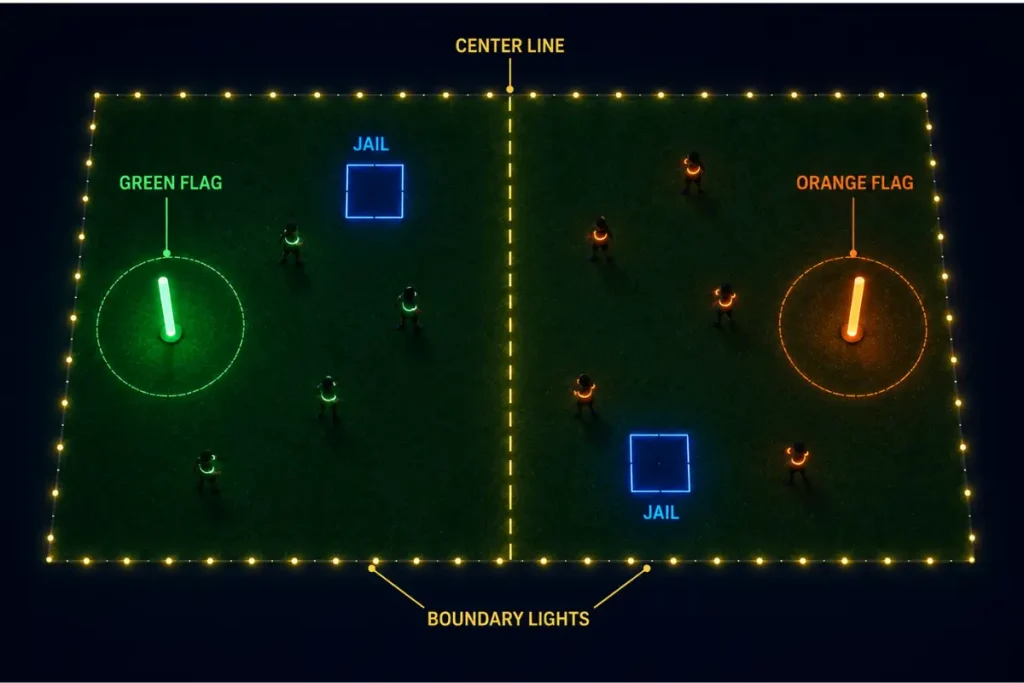
- Glow the flags. Tape or tie a large glow stick to each flag spot in your two colors. A searcher should spot it up close, not from across the field.
- Hand out team bands. Give every player two glow bracelets in their flag color. Now you can tell friend from foe, and nobody collides in the dark.
- Light the center line and jails. Run marker lights along the boundary and mark each jail with a bright, distinct color, so no one loses the line or wanders off the field.
- Brief the reduced-speed rule. Tell everyone: no full sprinting after dark, because a hole you can’t see ends the game fast.
- Do a dim-not-dark check. Stand at the far edge and confirm you can see moving shapes, so play stays low-light instead of blind.
How Darkness Changes The Game
Stealth beats speed
In nighttime capture the flag, neither team sees the enemy flag from a distance. Raw pace stops mattering. You listen. You crawl. The best raider moves low and slow. This changes how a flag grab feels versus the daytime game, where a fast dash often works.
Call your tags out loud
A tag is hard to feel and harder to see at night. Use a two-hand touch and say “tagged” so both players agree. The tagged player then raises a glow band to stay visible.
Keep the flag-light showing
A hidden glow is a cheat. The flag has to stay visible, same as the classic visible-flag rule. A dropped glow-flag returns to its spot, just like a tagged carrier drops the flag in the base game.
The quiet-whistle trick
Some groups let a leader whistle softly near each flag so searchers can orient. Keep it quiet, audible only within about 100-200 meters, or you hand the location to the other side.
Common Nighttime Disputes And How To Settle Them
Every group hits the same after-dark arguments. Here are the four that come up most in nighttime capture the flag, and how to settle each on the spot.
“Was that glow yours or theirs?” Pick distinct, saturated colors before start. When you honestly can’t tell at distance, treat the glow as an opponent and act accordingly.
“I couldn’t see the boundary.” Glow-mark the whole perimeter, not just corners. On any close call, a leader’s ruling is final and the round moves on.
“Did you actually tag me?” Two-hand touch, called out loud, and the tagged player raises a glow band. If nobody heard it, it didn’t happen.
“Where’s the jail?” Mark each jail with a bright light in a color used nowhere else. People lose the jail fast in the dark, so make it obvious.
Playing It Safe After Dark
Nighttime capture the flag is safe when you treat the dark as the real opponent. A few habits keep it that way.
- Walk the field in daylight first and flag every hole, root, and low branch
- Keep boundaries well clear of roads, water, and any drop-off
- Play in dim light, not pitch black, so people can see each other
- Every player wears a light, so no one is ever invisible on the field
- Set a reduced-speed rule: fast walking or jogging, no all-out sprints
- Leaders carry headlamps and watch the edges
- Agree a signal: 1 whistle means freeze, 2 whistles means game over
Related Night and Low-light Twists
| Glow-in-the-dark CTF | Leans fully into glow gear, with light-up orbs and full-body bands |
| Flashlight tag CTF | Tag with a beam instead of a touch, no need to close in |
| Indoor lights-off | Same darkness idea, walls and rooms instead of open field |
| Hunters twist | A roaming pair works the middle, adding dread to every crossing |
| Freeze instead of jail | Tagged players freeze in place until a teammate frees them |
Strategy Tips For After Dark
These only apply once the lights are out. Nighttime capture the flag rewards patience over pace.
- Move low and slow. A sprinting silhouette is the easiest thing to spot against a night sky.
- Cup your own glow behind cover, then flash it only to a teammate you trust.
- Stop and listen before you move. Footsteps and breathing give people away faster than sight.
- Send a quiet scout wide while a loud decoy draws defenders to the middle.
- Grab the flag, then freeze. Bolting lights you up, a slow drift back reads as nobody.
- Learn the boundary lights early, so you never drift out chasing a shadow.
Nighttime Capture The Flag FAQ
What do you use for flags in the dark?
Two large glow sticks or light-up orbs in clearly different colors. Tie or tape one at each flag spot. They stay visible up close, which keeps the classic visible-flag rule intact.
Do you need glow sticks or can you use flashlights?
Both work. Glow sticks are cheap and hands-free, so most groups start there. Flashlights suit a flashlight-tag version instead, where a beam counts as a tag.
How long do the glow sticks last?
Most burn 6-12 hours, far longer than a round. Don’t snap them until just before start so you get the brightest glow during play.
Can you play glow-in-the-dark capture the flag indoors?
Yes, with lights off and softer boundaries. The darkness idea carries over, but walls change the strategy. See our indoor capture the flag guide for the full setup.
Is capture the flag safe to play at night?
It is, with a daylight field-walk, lit boundaries, a light on every player, and a no-sprint rule. Dim light beats pitch black every time.
Take Nighttime Capture The Flag To Your Field
Grab a bag of glow sticks, wait for dusk, and run a round with your group. Rained out or short on space? Move it inside with the indoor lights-off version. New to the game entirely? Start with our beginner capture the flag rules, then come back after dark.
