Indoor capture the flag solves the problem every group leader hits eventually. Rain, snow, or a booked field, and 20 kids still need running around. Move it inside and the game changes shape. Tighter space, harder tags, walls that punish a full sprint.
Indoor capture the flag is the classic outdoor game played in a gym, hall, or large room, with two-hand touch tagging and taped floor lines instead of cones. Tight space favors defenders, so you shrink the safety radius and shorten rounds. Walls become the boundary rule that matters most.
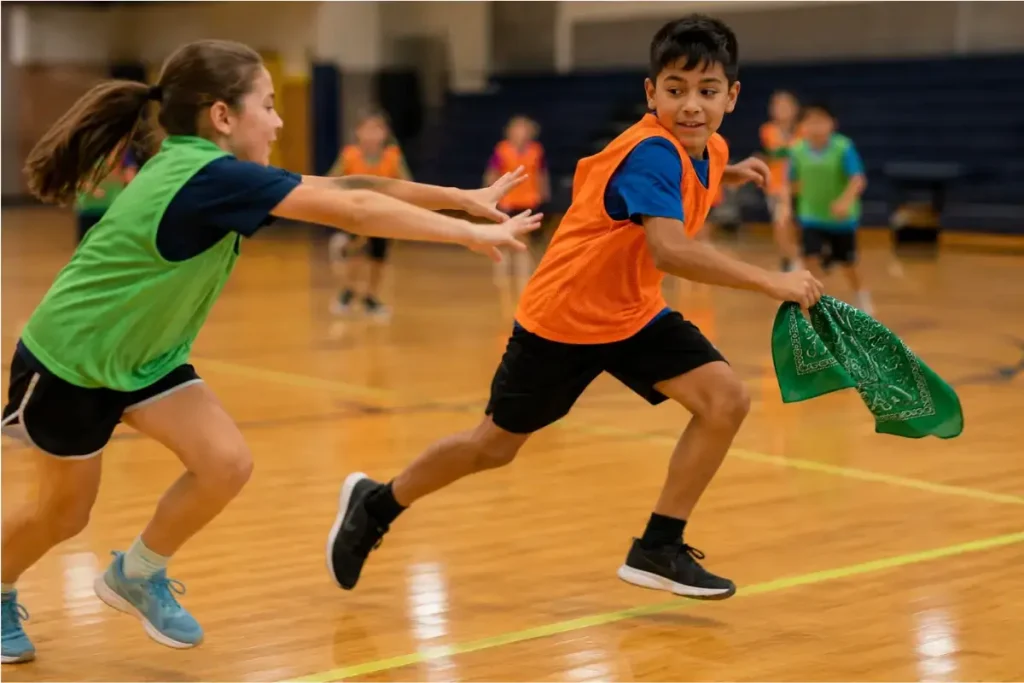
| Players | 8-25, split into two even teams |
| Time | 10 minutes per round, several rounds |
| Ages | 6 and up |
| Space | Gym, hall, or large room, 20 feet of length per team |
| Gear | Floor tape, 2 flags, hoops or cones, pinnies |
| Tag rule | Two-hand touch only, no exceptions |
Table of Contents
What Changes When You Move The Game Inside
Indoor capture the flag keeps the base game intact. Jail, freeing, the safety radius, how you win, all of it holds. For those, read the full capture the flag rules on our main guide. This post covers only what shifts indoors.
Four things change once you’re between walls. Tags go two-hand touch only, no exceptions. Floor tape replaces cones. Speed drops because walls don’t forgive. And defenders get stronger, so you shrink the radius to keep raids possible.
What You Need Indoors
Most of this is already in a gym closet. If you’re in a church hall or rec room, a roll of tape covers almost everything.
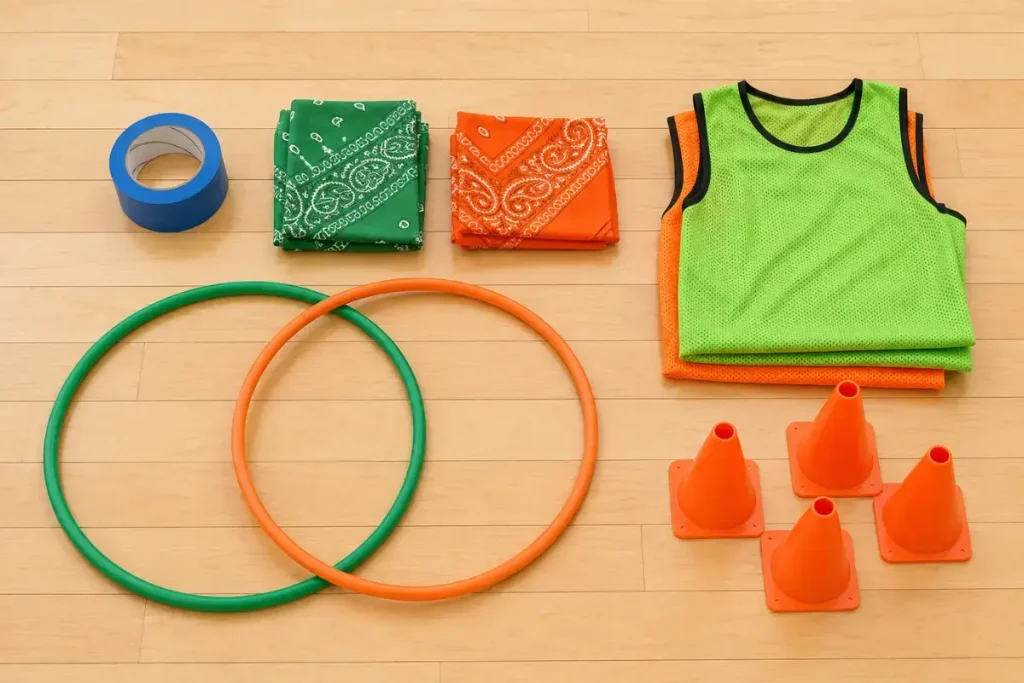
- Painter’s tape or floor tape for the center line and boundaries. It peels up clean and beats cones on a slick floor.
- Two flags in clearly different colors. Bandanas, pinnies, or beanbags all work.
- Hula hoops or cones to mark each jail and each flag zone.
- Two pinnie colors so nobody tags a teammate in a crowd.
One detail gym guides skip: don’t use the walls as your out-of-bounds line. Set the boundary 3 to 5 feet inside them. Kids chase hard and stop late. That gap is the difference between a fun round and a bloody nose.
No gym? A church hall, rec room, or cleared garage works. You need about 20 feet of open length per team, and a floor nobody minds you taping.
Indoor Field Setup In 5 Steps
Indoor capture the flag only differs from the outdoor game in how you mark and size the space. For team splitting and base field layout, use the full capture the flag rules.
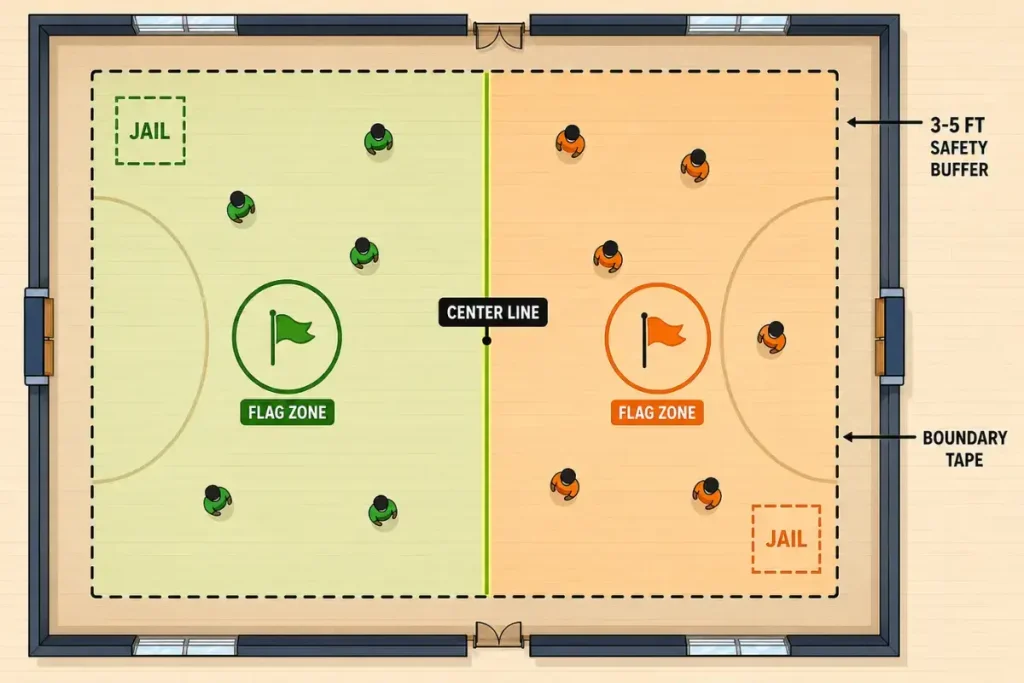
- Tape the center line across the middle. A gym’s existing half-court line works perfectly, so use it if you have one.
- Set the boundary inside the walls. Leave 3 to 5 feet of buffer on every side, so a sprinting player has room to stop.
- Mark each flag zone with a hoop. A 5-foot circle is plenty indoors, and it makes the safety radius visible on a flat floor.
- Put each jail in a back corner. Corners keep jailed players out of the running lanes, which matters far more indoors.
- Walk both teams around the boundary before play. Point at the buffer, the jails, and anything hard. Say the two-hand rule out loud.
How Tight Space Changes The Game
Two-hand touch, always
Indoor capture the flag runs on two-hand touch and nothing rougher. Bodies are closer, floors are hard, and a one-hand grab turns into a pull. Say it before the first round. Enforce it on the first violation, not the third.
Defenders get the advantage
In indoor capture the flag, less ground to cover means guards win more. That flips the balance from the outdoor game, where runners have room to work. Shrink the safety radius to 5 feet so attackers still have a real shot.
Shorter rounds, more of them
A gym round runs quicker than a field round. Cap it at 10 minutes and play more of them. Teams reset, kids stay fresh, and nobody camps a corner for 20 minutes. Short rounds also hide uneven teams, since a blowout ends before anyone notices.
Walls are not boundaries
The taped line is the boundary. A player who crosses it is out of bounds, even if the wall is another 4 feet back. That buffer only works if you call it every time.
Common Indoor Disputes And How To Settle Them
Every gym game hits the same arguments. Here are the four that come up most in indoor capture the flag. Each has a fix that ends it fast.
“I was still in bounds.” Tape the full perimeter, not just the center line. If a foot touches the tape or beyond, they’re out. A referee’s call is final and the round moves on.
“That wasn’t a tag, that was a shove.” Two-hand touch is the standard, and indoors it’s not negotiable. First deliberate shove sits the player out a round. Hold that line early and the rough play stops.
“You can’t camp the hoop.” Correct. Defenders stay outside the flag circle unless an attacker steps in first. On a flat gym floor the hoop makes this obvious, so there’s no arguing the distance.
“The furniture counts as cover, right?” Decide before kickoff, not mid-round. In a hall with chairs or bleachers, either they’re in play as cover or they’re out of bounds entirely. Pick one and say it out loud.
Playing It Safe In A Gym
Indoor capture the flag concentrates everything into a smaller box. A few habits matter more here than they do outside.
- Keep the boundary 3 to 5 feet off every wall, and off the stage or bleachers too.
- Move or rope off anything hard: chairs, ball carts, piano, equipment racks.
- Two-hand touch only, enforced from the first round.
- No sliding or diving on a gym floor. Feet stay under you.
- Watch the corners, where collisions cluster most.
- Check footwear. Socks on a polished floor end games fast.
Related Indoor And Small-Space Twists
Once indoor capture the flag clicks, these twists suit the same tight space.
| Nighttime capture the flag | Glow sticks mark players and flags. Stealth beats speed after dark. |
| Lights-off gym | Same gym, lights down, glow bands on. Cover comes from darkness, not furniture. |
| One-flag | One neutral flag at center court. Both teams race the same target, which suits tight space. |
| Freeze instead of jail | Tagged players freeze where they stand. No jail zone needed in a small room. |
| 4-base | Four corners, four teams. Spreads a big group across a gym without a center bottleneck. |
Strategy Tips For Tight-Space Play
These only work indoors. Space is the constraint in indoor capture the flag, so everything bends around it.
- Hug the sideline on your run. The middle is where every defender is already looking.
- Send two attackers at the same corner. One guard can’t cover a hoop and a lane at once.
- Walk, don’t sprint, on the approach. Speed gets you spotted and gets you stopped by a wall.
- Free your jailed teammates early. Indoors, one extra body swings the numbers fast.
- Time a raid right after a defender crosses to chase. That gap closes in seconds in a gym.
- Use bleachers or a doorway as a sight break if the room allows it.
Indoor Capture The Flag FAQ
Can you play capture the flag indoors?
Yes. A gym, hall, or large room works with two-hand touch tagging and taped floor lines. Tighter space favors defenders, so shrink the safety radius to keep raids possible.
How much space do you need to play indoors?
About 20 feet of open length per team is a workable minimum. A full gym is ideal, but a church hall or cleared rec room handles 8 to 16 players fine.
What do you use for boundaries on a gym floor?
Painter’s tape or floor tape, or a gym’s existing half-court and sideline markings. Keep the boundary 3 to 5 feet off the walls so players have room to stop.
How do you stop indoor games getting too rough?
Two-hand touch only, stated before the first round and enforced on the first violation. No sliding or diving, and move anything hard out of the play area.
Is indoor capture the flag good for PE class?
It suits a gym period well, since rounds are short and the rules are quick to explain. Use pinnies, cap rounds at 10 minutes, and keep one adult refereeing the boundary.
Take Indoor Capture The Flag To Your Gym
Tape a line, grab two bandanas, and run a round before the rain stops. Want the outdoor version first? Start with our beginner capture the flag rules. Ready for a twist after dark? Try nighttime capture the flag next.
